
Many healthcare providers pay hundreds or even thousands of dollars each month for platforms such as ZocDoc and Psychology Today. These platforms may send profile views, inquiries, or appointment requests, but that does not automatically mean they are producing profitable patients.
The problem is usually not the platform itself. The real issue is that most practices track how much they spend, but they do not track what happens after someone views the profile or books an appointment.
Without proper patient acquisition tracking, it is almost impossible to calculate your ZocDoc ROI or decide whether the platform deserves another month of your marketing budget.

Profile Views Do Not Equal Revenue
A platform may report that your profile received hundreds of views. That number can look impressive, but views do not pay your staff, cover overhead, or improve cash flow.
Even booked appointments can be misleading. A patient may schedule an intake, cancel at the last minute, fail to show up, or attend one session and never return.
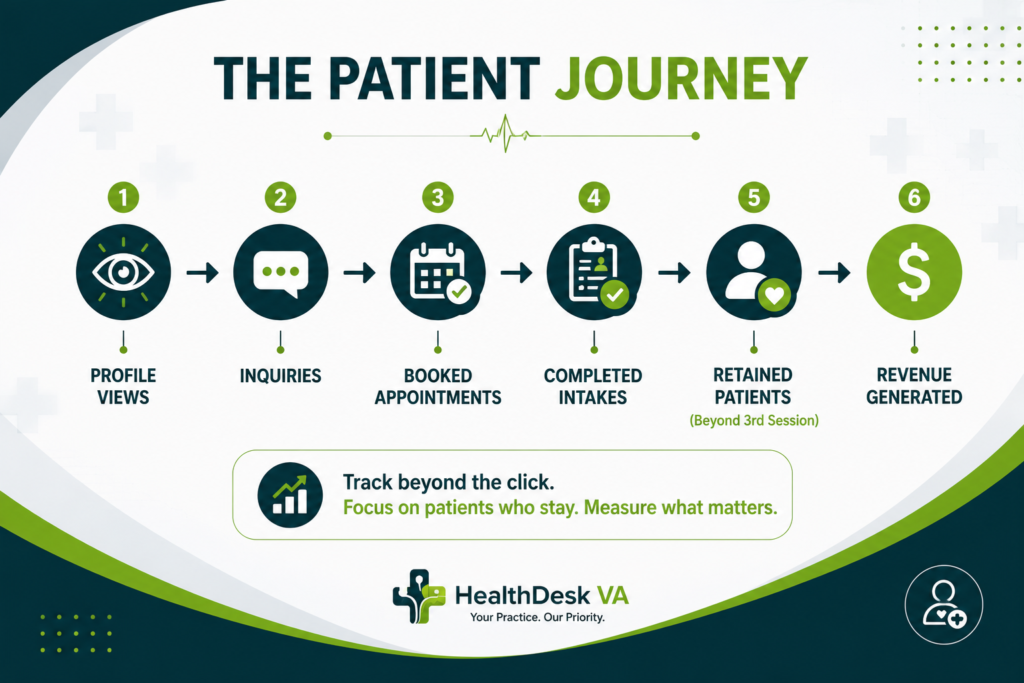
To understand whether a platform is working, you must follow the patient journey beyond the initial click.
A useful tracking process should measure:
- Profile views
- Calls, messages, or appointment inquiries
- Booked intake appointments
- Completed intake appointments
- Patients who continue beyond the third session
- Revenue collected from retained patients
These numbers provide a much clearer picture than the dashboard metrics offered by most listing platforms.
Why Retained Patients Matter More Than Booked Patients
A booked patient is not always a profitable patient. Practices often calculate cost per booking without considering cancellations, no-shows, insurance eligibility issues, or early dropouts.
For example, suppose you spend $500 per month on ZocDoc and receive ten bookings. At first glance, your cost per booking is $50.
However, if only six patients complete the intake and only three remain active after the third session, your real acquisition cost is closer to $167 per retained patient.
That is the number you should use when evaluating ZocDoc patient acquisition performance.
Track Patients Beyond Session Three
Using the third session as a retention checkpoint helps separate casual inquiries from patients who are more likely to continue care.
This is especially important for psychiatrists, therapists, PMHNPs, and other behavioral health providers. Long-term patient value usually comes from ongoing treatment, not a single appointment.
You can adjust the retention point based on your specialty, but the goal remains the same: measure patients who continue receiving care, not just those who enter your schedule.
Ask Every New Patient One Simple Question
One of the easiest ways to improve healthcare marketing ROI tracking is to ask every new patient:
“How did you find us?”
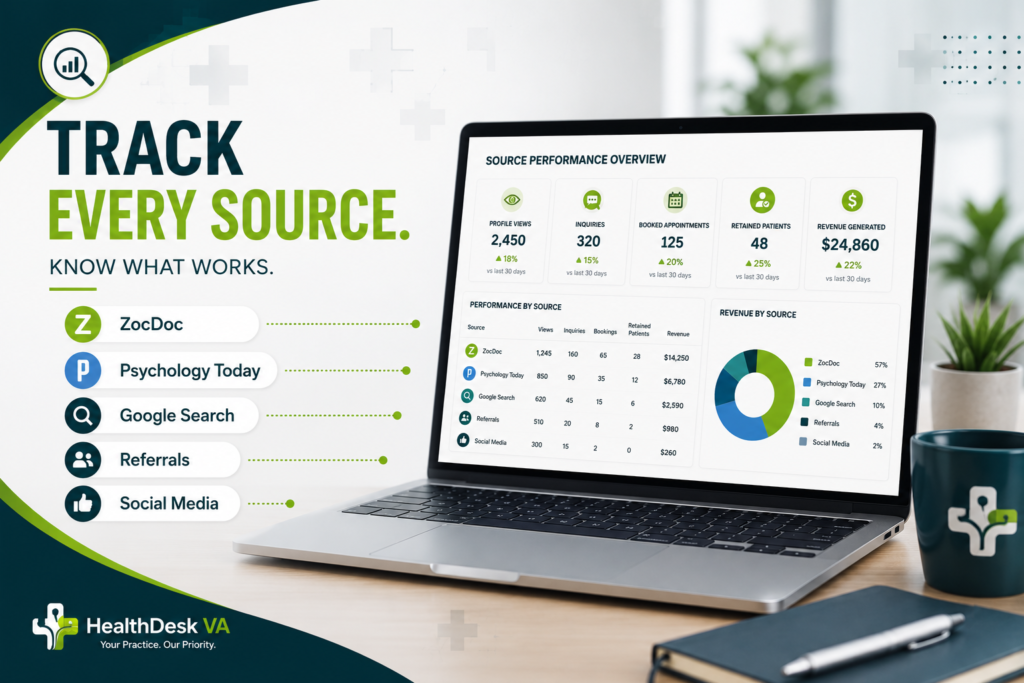
Add the answer to the patient intake form, CRM, EHR notes, or a simple spreadsheet. It takes only a few seconds, but it helps identify which platforms are producing actual patients.
Use consistent source labels such as:
- ZocDoc
- Psychology Today
- Google Search
- Physician referral
- Insurance directory
- Social media
- Existing patient referral
Avoid vague categories like “online” or “internet.” Those answers make it difficult to compare one source against another.
Calculate Cost Per Retained Patient
Once you have at least 30 to 90 days of clean data, compare the amount spent on each platform with the number of retained patients it produced.
Use this basic formula:
Monthly platform cost ÷ retained patients = cost per retained patient
For example:
- Monthly ZocDoc cost: $600
- Retained patients: 4
- Cost per retained patient: $150
Next, compare that amount with the revenue collected from those patients. Include completed visits, insurance payments, patient balances, and expected ongoing treatment value.
This helps you determine whether the platform is profitable, barely breaking even, or costing more than it produces.
Give Each Platform 90 Days of Clean Data
Do not cancel a platform after one slow month. Patient demand, provider availability, insurance participation, profile quality, response time, and appointment capacity can all affect performance.
Instead, collect at least 90 days of accurate data before making a final decision.
During this period, confirm that:
- Your profile information is complete and accurate
- Accepted insurance plans are clearly listed
- Appointment availability is updated
- Inquiries receive a timely response
- New patient sources are logged correctly
- No-shows and cancellations are tracked separately
After 90 days, the numbers should make the decision clearer. You can continue the platform, improve the profile, negotiate the agreement, reduce spending, or cancel it.
Patient Acquisition Tracking Requires More Than Marketing
Patient acquisition does not end when someone books an appointment. Scheduling, eligibility verification, intake follow-up, reminders, billing, and payment collection all affect whether that patient becomes profitable.
A strong tracking system connects the marketing source with the patient’s full financial journey.
This allows the practice to see which platforms generate:
- Patients who attend their appointments
- Patients whose insurance can be verified
- Clean claims and timely payments
- Long-term treatment relationships
- Reliable revenue
Without this connection, marketing reports and billing reports remain separate, leaving providers to make decisions based on incomplete information.

Make Platform Decisions Based on Data
ZocDoc and Psychology Today can work well for some practices and poorly for others. The answer depends on your specialty, location, availability, payer mix, intake process, and patient retention.
The goal is not to keep or cancel every platform. The goal is to know exactly what each platform is producing.
When you track views, inquiries, completed intakes, retained patients, and collected revenue, your ZocDoc ROI becomes measurable. The decision is no longer based on assumptions.
A medical billing and RCM expert can help connect patient acquisition data with scheduling, claims, payments, and retention. This gives your practice a more accurate view of which marketing channels are truly contributing to revenue.